

The Silver Whisperer
The subtle, nuanced world of Ben Miller.

Silver whisperer. Antiques evangelist. But Ben Miller may not be quite what you expect of those phrases.
For the un-initiated, the world of antiques might appear a touch standoffish and stuffy.
Not Ben Miller. He is, nonetheless, one of the premier experts and dealers in fine, rare, and collectible silver. Also one of the youngest. He’s also the founder of Fine Objects Society (proud to be a card-carrying member, do please join.)
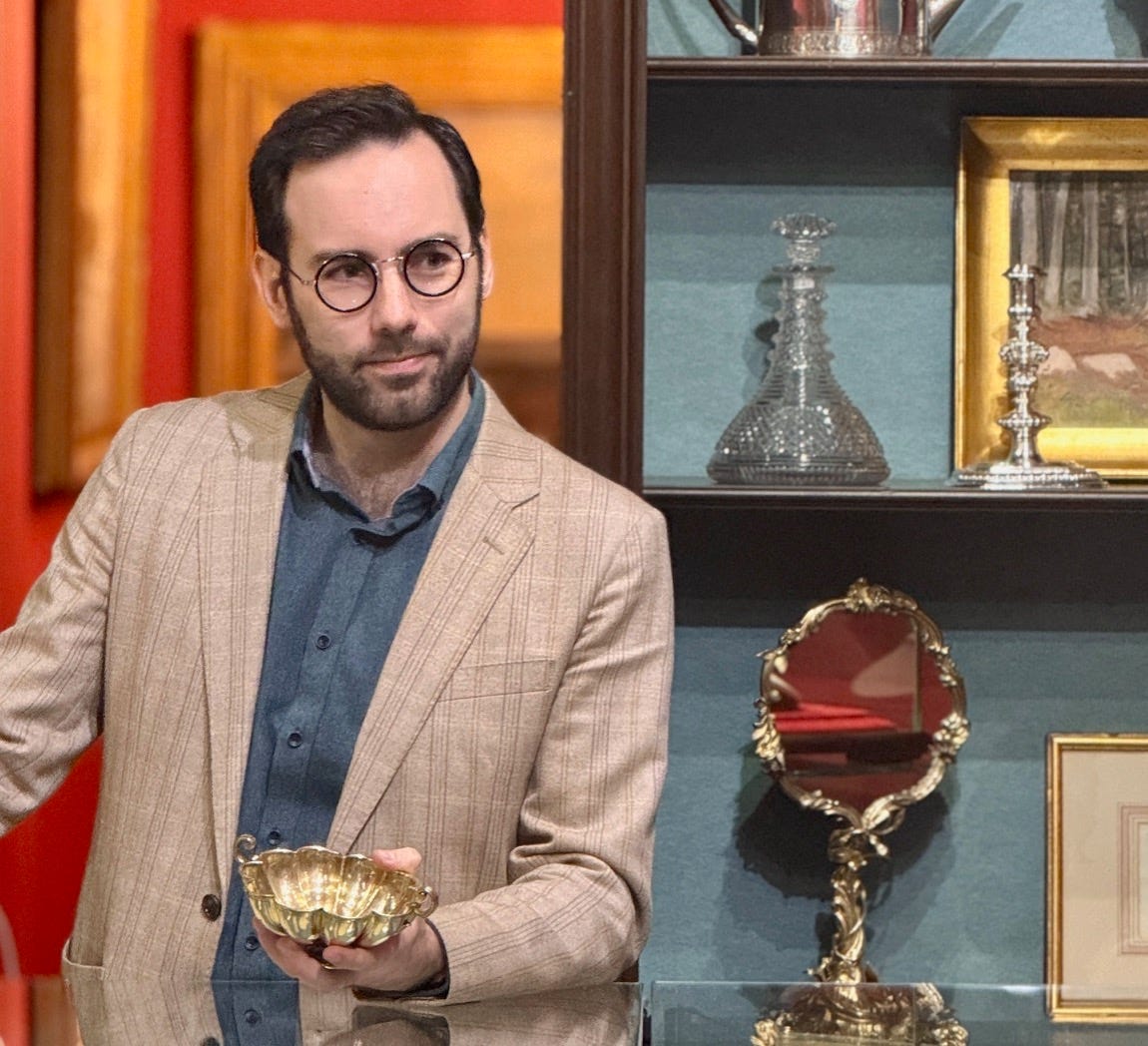
We’ll get to the silver story in a bit, but FOS is an apt example of what sets him apart from the fusty: a clear idea of the wider eco-system in which antiques function and, more importantly, a genuine curiosity about and empathy for the buyer: how they think, what they want, what moves them, what their goals are, how they can satisfy the goal. Rather than the art of the deal, it’s about the connection (though it starts, as it should, with the object.)
This desire — and ability to connect — led him to develop and host the cult-favorite Curious Objects podcast for The Magazine ANTIQUES. To hear him tell the inception story, "It was storytelling that drew me to antiques originally, and I realized early on that antiques dealers are natural born storytellers. But I also realized that a lot of them are lousy writers! So I thought, why not give them a chance to tell the stories about these objects in the way they do it best, talking. I pitched that idea to the magazine and we were off to the races."
What Ben loves about it isn’t just the story but the way it reaches people who you wouldn’t expect. As he says, “It reinforces for me the idea that antiques live deep in the human psyche.”
Of course, you don’t just roll out of bed at the age of 10 (or 20) and decide that your path in life is that of a silver dealer (let alone antiques evangelist.)
Instead, it was a guy in a bar.
Ok so this guy happened to be a silver dealer who decided to take a chance on a neophyte, and gave him a job, starting with research. And a career Ben has come to love.
Yes, the antiques business can be a bit opaque. (Some might even say a touch slippery.) So what keeps Ben around? "The beauty of the objects, the allure of exquisite craftsmanship, the detective work, and the physical connection to the past."
And who wouldn’t want that?
C: The Journey Begins: Why did silver “stick”?
BM: It was happenstance that brought me into the silver trade, but I quickly learned that silver is one of the best storytelling materials. It's literally money. That means people have always paid close attention to it, and compared to other media, silver is exceptionally well documented. Whole regulatory systems were invented just to track it. Even our language shows that - words like sterling and hallmark come from the silver business. You can often trace the history of specific pieces with astonishing resolution.
C: Fox or Hedgehog? Have you always been one to “go deep” into an area? Or more of a multiple interests person?
BM: I love a rabbit hole, but I will say I’m a little bit of an oddity in antiques. I was not a child collector. I was not that 16-year-old going to the flea market…I’m not that, though am envious of people who did that when they were younger. But I suppose there was always something there. The story goes that when we were living in Italy when I was very young (around 5), my parents dragged me around to every art museum in the country. I hated that and made my feelings known.
One day at the Ufizzi, we stepped into the gallery containing Botticelli’s Birth of Venus – and according to my parents, I suddenly quit whining, walked over to the painting, stared up at Venus, and in a trance-like state muttered, she’s so beautiful…
C: Why This and Not That? What is it about this particular area that speaks to you over the others?
BM: Silver does things to me as a material. SIlver feels magical to hold.
It’s not something that I felt the first time. But with enough accumulated experience…I’m going to use a piece of music as an analogy - think about a song you’ve listened to a hundred times. The first time you heard it, maybe you liked it, maybe you even loved it. But every time you've heard it since, you've been developing a relationship with it. And it calls your memory back to that first time, and all the other times, and makes you love it and cherish it so much more deeply. That's what a great piece of silver can do for me.
C: Let’s talk patina. Some people are patina people. Others aren’t. And in your world, you need to be. What about the role of patina in your world?
BM: Patina is one of those terms antiques people obsess over. Understanding and assessing it can be extremely complicated (and fun!). An object can tell you a lot about itself through its patina - how it's been used, abused, cared for, stored, and enjoyed.
But as far as collecting goes, desirable patina can be very different from object to object. If you have modernist candlesticks by Georg Jensen, they want to be shiny, reflective, bright like a mirror. But if you look at a piece of 17th C English silver, and it looks bright and shiny and mirror-like, that's a tragedy. In that instance, the patina you want is richer, deeper, more complicated. Its age and use, even the techniques used to make it, lead to these subtle differences in the surface and the color. Tiny little dents and scratches, irregularities in the alloy, and other factors contribute to a deep, bluegrey, almost matte surface. When you pick that up, if you know what you're looking for, it just makes your heart beat faster. It shows its age like an old friend. It’s a living, breathing thing.

C: How do you know you’re in the presence of quality?
BM: If I had a complete answer to this…I’d be a rich man.
On one level, you just know. We’ve all seen something in a museum or a gallery or even a flea market… something just stops you in your tracks…and even if you don’t know what it is…you know it’s amazing. And if you have that reaction you’re not wrong. There’s something there.
Whether it’s excellent or even of quality is a different question. What it’s worth is a separate question too. But as a professional, you have to trust that you’ve trained your eye and your subconscious so that on average, your judgment is going to be reliable. And there’s no way to do that other than to see and handle thousands of things. Reading books can help too. And you need to fight overconfidence, which can be a dangerous thing… As we’ve seen, billionaires can get the feeling that being good at one thing means they're good at everything. The same can be true on a smaller scale in this field. It’s crucial that over the long term, you’re approaching collecting with humility.
Making hot chocolate in a silver pot from 1703. Because antiques were made to be used. Even when they're 300+ years old. Chocolate pot, 1703, by Peter Pemberton, Chester. Video by Jess Coles.
C: Connoisseurship in the 21st Century. In an age of algorithms and influencers, what does it mean to be a connoisseur? Why is there value in it?
BM: I’m part of a generation of dealers who are digital natives. I do know that a lot has changed from previous eras: there is so much more information available at your fingertips and your ability to research categories. That’s a wonderful thing. And not that I want to gatekeep, but it can also be misleading.
First there’s imagery. I can’t count the number of times I’ve purchased something online from photos, only to discover some problems with the object. Maybe it’s a fake. Or there are condition problems. Or a variety of issues. Over time I've gotten better at evaluating from a distance, but photos or videos alone will never be fully reliable.
The quantity of information available can also breed overconfidence. It can be frustrating as a dealer trying to sell a piece of exceptional quality which might (based on auction photos) look pretty similar to pieces priced much lower. Your client sees those other pieces and thinks your prices are crazy. Now, I love to have those conversations - talk through why one thing is worth x and something else is worthy. But too often, I don't even get the chance - the client never stops to ask.
And that hesitation to engage (however understandable) is frustrating for the whole notion of connoisseurship. It shows a breakdown in trust between dealers and collectors.
In previous eras, dealers had much more control over information. That made it easy to limit competition and charge huge markups. Things are different today, and the antiques trade has not evolved to keep up.
I want to build my career around finding and creating real value, not artificial hype or deception or jealously guarded secrets. That means research, connoisseurship, and legwork. And of course, it means telling a good story, and hoping that my enthusiasm is infectious.
The Holy Grail: What is the single most sublime, unattainable, or mythic thing? And if you were to acquire it, what then?
BM: Does it have to be real?
C: Interesting question. Try me.
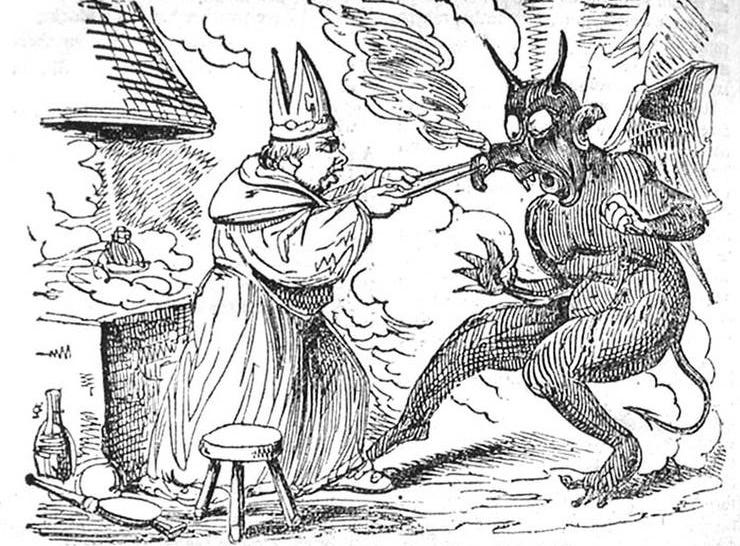
Well I’m not sure whether my holy grail piece exists or not. Actually I’m 99.9% sure it doesn’t. But here goes. The patron saint of gold and silversmiths is St Dunstan, who was a 10th C monk and silver/goldsmith. Story is that he was working in his smithy one day when a demon showed up. And St. Dunstan poked him with the hot poker and sent him back to hell. There was a ring made by St. Dunstan reputedly, a gold ring set with a sapphire. It showed up in the royal inventory for Edward I. And it never appears subsequently in another royal inventory. But I like to think that it's stuck in the grout somewhere in the Tower of London, and someday someone just finds it.
But I was also thinking that when Aristotle tutored Alexander the Great, part of the curriculum would have been the Illiad and the Odyssey on papyrus with marginalia with Aristotle and more by Alexander the Great.
C: Um, OK. But what about something real?
BM: Oh, I can’t really say. Someone else might get there first.
C: Because only in nature is beauty infinite. Thanks, Ben. And may you always get there first.
***
Ben’s Connoisseurship Tool Kit: If you were assembling a survival kit of sources—books, people, archives, Instagram accounts—what are the three most important to you? And why?
The Watson Library at the Metropolitan Museum - I hate to imagine doing my job without it. Among other things, they have what is probably the world's best collection of auction catalogs - centuries of them.
I can't even begin to estimate how much time and money archive.org has saved me. Their repository of digitized books and catalogs has so many critical sources that would otherwise be very difficult to track down.
To do a little logrolling - Fine Objects Society is currently developing a tool called the Rolodex, which will connect people with experts to help them answer questions about objects (think Antiques Roadshow on demand!). We haven't launched it yet, but I expect it'll be a fantastic resource for connoisseurial insight.
[Ed: To learn when it goes live, be sure to sign up to the mailing list or become a member.]
Wonderful article. Can't wait for the next one.